
Belgium’s lethargic response to the wildfire menace
The wildfire crisis that has affected many European countries did not spare Belgium. The intensity of this phenomenon and the country's slow reaction to it are causing growing concern.
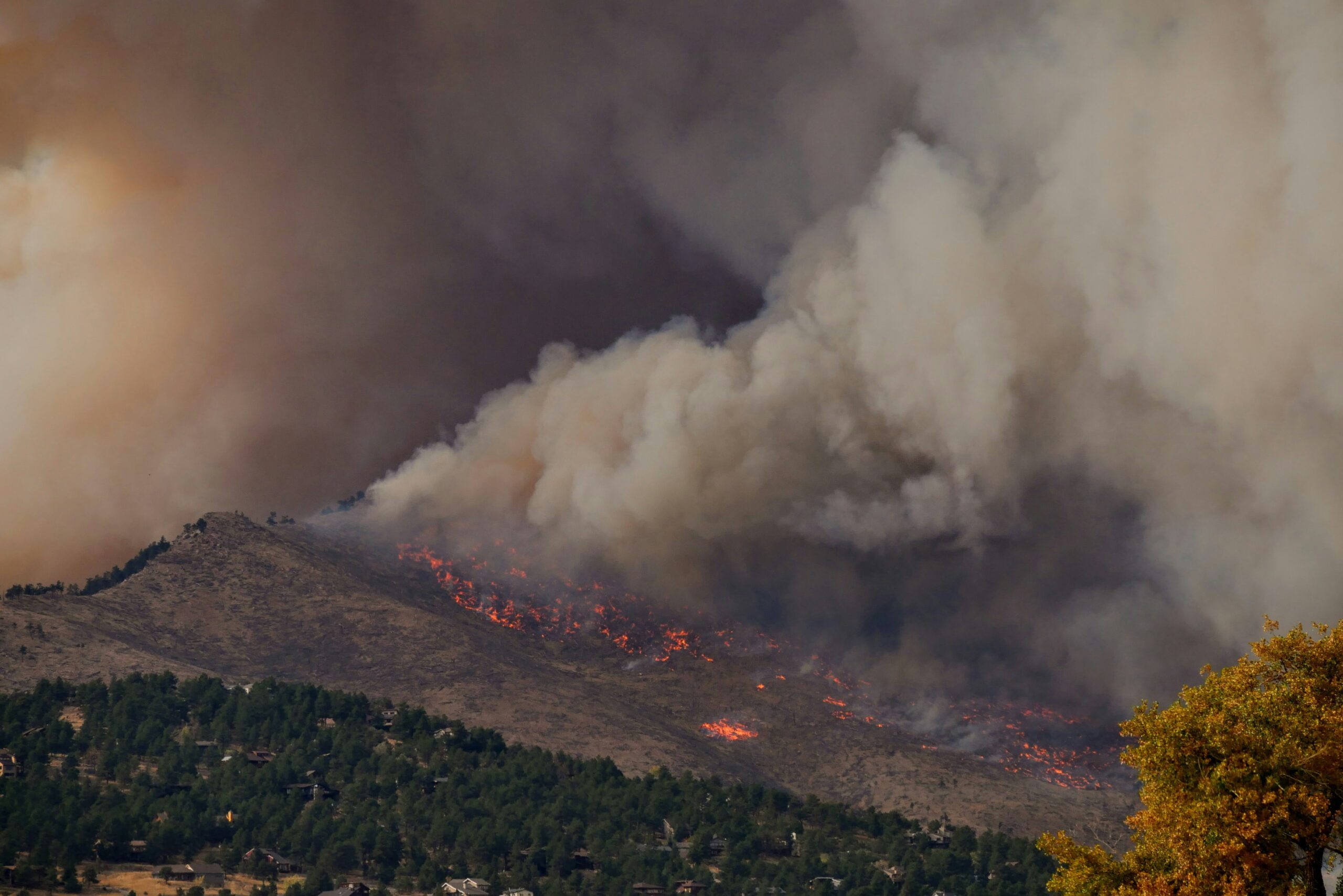
© Malachi Brooks / Unsplash
The heatwave that recently baked Europe did not spare Belgium. The country experienced an unprecedented rise in excess mortality between Thursday 18 June and Monday 29 June. According to preliminary official data, 1,222 additional deaths were recorded during that period, of whom 530 were among people aged 85 and over. Belgium also recorded its highest daily death toll since the first wave of the coronavirus pandemic.
The rise in temperature is also prompting worries about wildfires. As early as April 2026 – one of the driest Aprils on record – the whole country found itself at moderate to high risk of wildfires.
The concerns are certainly valid. Alas, no data is collected systematically across Belgium, so the situation is currently hard to quantify.
According to partial data collected by the Global Land Analysis & Discovery laboratory at the University of Maryland, Belgium lost 1100 hectares of forest cover to fires between 2001 and 2025. Total losses (i.e. those due to other factors too) over the same period amount to 130,000 hectares. Fires therefore account for less than 1% of the losses.
While the threat should not be discounted, this figure remains well below that of other European countries. Southern Europe, in particular, has seen its forests ravaged year after year by fires of ever-increasing scale.
Southern Europe: the hardest hit by fire
In partnership with the European Data Journalism Network, the Mediterranean Institute for Investigative Reporting (MIIR) has looked into the issue. By analysing data from the European Forest Fire Information System (EFFIS), MIIR paints an alarming picture of the situation across Europe.
According to MIIR, between 2015 and 2025, Europe recorded 134 fires that covered an area of over 5,000 hectares. 61 of them burned more than 10,000 hectares. Such fires were relatively rare at the start of the decade. They have become increasingly frequent since 2021.
The most destructive forest fires remain heavily concentrated in southern Europe. Spain and Portugal together account for 49 of the 61 fires over 10,000 hectares recorded during the decade in question. Greece, in particular, has endured some of Europe’s most severe wildfire-related disasters. In particular, the Evros fire in 2023 was the largest wildfire recorded by EFFIS since monitoring began in 2000.
During the fire seasons (April-October), a total of over 2.6 million hectares of natural vegetation (scrubland, grasslands, forests undergoing regeneration, abandoned farmland, etc.) burned across Europe. This compared with around 915,000 hectares of dense forest.
Belgium remains underrepresented in the EFFIS data. Over the period analysed, MIIR recorded 1,092 hectares of burnt vegetation, with a peak in 2021 (588 hectares). Like other northern European countries, Belgium remains comparatively less exposed to wildfires than countries further south. It should be noted that these figures may also be incomplete.
Although the phenomenon is hard to quantify, Belgian weather patterns have changed over the last twenty years in a way that could increase the risk of fire.
Data from the Royal Meteorological Institute of Belgium (IRM) shows a clear increase in the number of hot days (where the peak temperature was 30 degrees or higher). New records were set in 2020 (12 days) and 2022 (13 days).
Another indicator of an increased drought risk is the number of days with precipitation. This trend reached extreme levels as early as 2018 (142 days compared with the normal of 198.7 days), and again in 2022 and 2025 (148 days and 145 days respectively, against a normal of 189.8 days).
But the IRM data also offer a glimpse into another aspect of Belgium’s climate future. This is what researcher Sébastien Doutreloup, of the University of Liège, calls “climate extremisation”. The data show that heat, rainfall and other meteorological factors are set to become more unpredictable and extreme. We will see years of severe drought followed by years of heavy rainfall, with devastating consequences. In Belgium, the memory of the 2021 floods, which claimed 39 lives, is still fresh in everyone’s minds.
Doutreloup explains: “We can see that back in the 1950s, 1970s and earlier, when we weren’t yet too affected by global warming, we had virtually the same amount of rainfall every month. Even though we are heading towards very significant global warming, on an annual basis we may still have the same amount of rainfall in Belgium. However, there will be much more in winter and much less in summer.” Amounts may also vary widely from one year to the next.
According to Doutreloup, the transformation is also due to a profound change in atmospheric conditions. “Belgium’s climate is becoming more Mediterranean.” The issue of water conservation will arise.
Doutreloup stresses that drought is what can seriously undermine a forest ecosystem. The proliferation of pests which attack and weaken trees is a contributory factor. The fact that Belgium is facing a future of heatwaves “is really the final straw” for fire risk, he says.
What can be done?
Belgium’s wildfire risk is being taken seriously at the highest levels. In its national risk assessment for the period 2023–2026, the National Crisis Centre considers the risk to be high. “The most likely scenario is that of a very severe forest fire causing damage to between 50 and 500 hectares in a little-visited natural area (≤ 1,000 visitors per day) and threatening one or two residential areas or leisure sites.”
“In terms of the impacts of wildfires, there are many but the environmental one is the most significant”, clarifies the National Crisis Centre. To date, this institution judges the various impacts (human, environmental, societal and economic) of wildfires to be “low”, noting that most such impacts stem from the indirect effects of fires.
The consequences of any given fire last long after the flames have been extinguished. An example: gaps in vegetation left by a fire are likely to be colonised by invasive species. “If a fire occurs near our national border, there may also be an impact on neighbouring countries”, the National Crisis Centre adds.
The alarm has now been sounded by a report published in March 2026 by the Belgium Wildfire Network (BWN). This network of organisations, set up by the Universities of Ghent and Liège, is concerned about Belgium’s lack of preparedness.
“Climate change is increasing wildfire risk across Europe, including in countries traditionally considered less fire prone, such as Belgium”, the BWN warns. Longer droughts and changes in land use – through urbanisation and forest degradation caused by insects, for example – are creating conditions conducive to large-scale fires that are difficult to bring under control. “Belgium’s dense wildland urban interface (WUI), limited public awareness, fragmented governance, and lack of wildfire expertise further increase vulnerability.”
The Belgium Wildfire Network also points to a lack of data. To rectify the situation, it has drawn up a list of possible actions. These include establishing a national database of forest fires; aligning with neighbouring countries in terms of risk assessment and training; and conducting further research into the wildfire phenomenon.
The BWN’s report also highlights another (typically Belgian) challenge: “Flanders and Wallonia often use different systems (e.g. operational and tactical maps), creating operational inconsistencies and potential confusion during interventions.” The BWN urges a harmonisation of objectives and procedures across the linguistic border.
Sébastien Doutreloup, the researcher, regrets the lack of action on climate-change adaptation at the national level in Belgium. However, he highlights several concrete measures taken on a smaller scale in Wallonia (the French- and German-speaking region in the south of the country).
“Locally, there are still things that complement one another”, he says, whilst noting the ongoing lack of coordination. Above all, Doutreloup believes that these adaptation strategies are just taking too long to become operational. Climate change, he points out, will not wait.
This article is published in collaboration with the European Data Journalism Network in the context of ChatEurope. Organisation and coordination by MIIR, with the collaboration of the EDJNET network.
Original source: https://voxeurop.eu/en/forest-wildfire-menace-belgium/.
