
The Belgian education system leaves disadvantaged students behind
The number of Belgian students dropping out of school is increasing steadily year after year, despite the overall wealth and connection of the country. Our partners at Voxeurop investigated the reasons behind this discrepancy, to understand why is Belgium falling behind on such a critical issue.
© Unsplash / Kyo Azuma
“School dropout rates are skyrocketing”; “a situation that’s worse than ever”; “the stats are an underestimate”. The headlines paint a worrying picture of Belgium‘s school system. Yet the problem remains somewhat abstract, given the disparities in methodology that surround the main indicators: days of absenteeism, early school-leaving rates, grade averages and so on.
Belgium’s French Community (one of the country’s three official linguistic groupings) publishes its “Education Indicators” annually. This uses the benchmark of the dropout rate “without certification”, i.e. the percentage of students leaving the school system without obtaining a qualification. The figures in question show a slight increase in this rate over the past few years: 3.9% for the 2020–2021 school year, rising to 5.6% for 2022–2023. The trend should be viewed with caution: the relatively low figure for the 2020–2021 school year is an exception, with other years also recording rates around 5%.
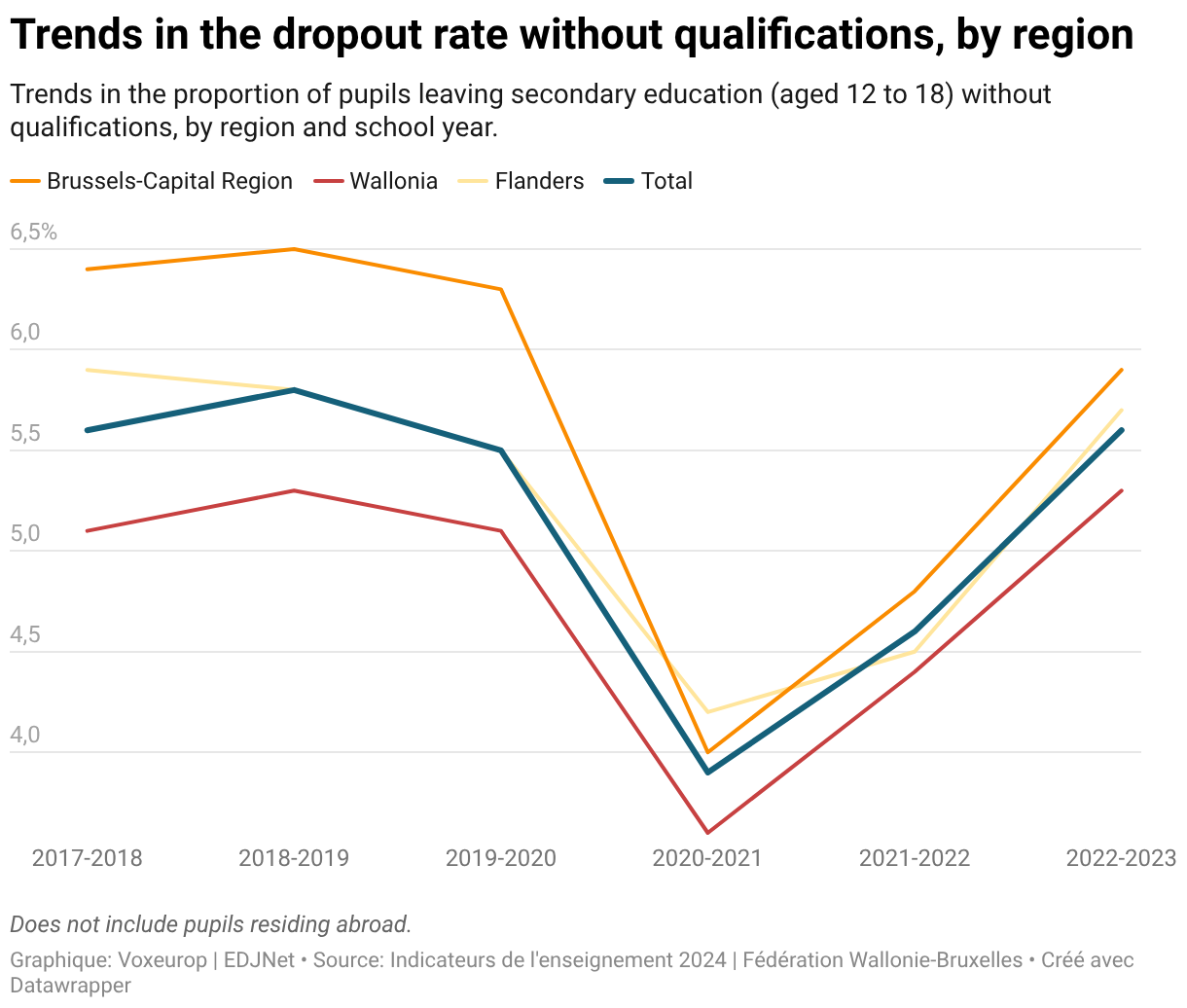
The French Community’s report shows that the rate varies depending on gender, age, the school track attended, and the type of education. For the 2022–2023 school year, the most recent for which the community has data, boys are more likely than girls to drop out of school without a qualification (6.5% compared to 4.5%). The disparities are even more striking between school tracks: while academically-oriented students have a dropout rate of 2%, the figure was 10.1% for those in vocational tracks.
These statistics can be considered relatively reliable as they are based on the French Community’s internal data. However, comparing them with other sources remains difficult due to differences in data-collection methods and calculation techniques. Beyond Francophone Belgium, methodologies vary by linguistic community (the others being Flemish and Germanophone). In Belgium, even the education system is divided into three by the language borders.
For Eden Glejser of the Coordination of NGOs for Children’s Rights (CODE), even the available figures need to be nuanced: “The cases identified [by the French Community] are children who have been found to no longer meet the compulsory schooling requirement.” School dropout encompasses many more scenarios, such as children “at risk of educational failures”; those enrolled in retention programmes; and others whose motivation for school is intermittent.
“School dropout is a complex [and] multifactorial issue”, says Eden Glejser, while acknowledging that the problem is growing. The changing school environment; a rise in anxiety; bullying; a feeling that education has lost its meaning – behind a seemingly discrete phenomenon lies a systemic issue requiring tailored solutions.
Europe’s two-tiered education system
School dropout has been one of the major challenges of European education policy for years. As set out in the 2021 Strategic Framework for European Cooperation in Education, EU countries aim to reduce the proportion of students leaving education and training prematurely to below 9% by 2030. The figures collected since 2002 confirm that the majority of European countries have already achieved this goal.
The Italian news outlet Openpolis, one of our partners within EDJNet, has analysed statistics on young Europeans aged 18 to 24 who have left school with no more than a lower-secondary education diploma. In its view, the EU’s positive results should be taken with a grain of salt.
In fact, the decline in early-school-leaving rates observed across the EU is not evenly distributed. While southern Europe has tackled the issue head-on and managed to keep students in the classroom, northern European countries seem to be moving in the opposite direction.
“Over the past decade, Cyprus has gone from a rate below 9% (6.8% in 2014) to 11.3% today”, according to Openpolis. “Germany, which reached its 2020 targets as early as 2014 with a rate of 9.5%, has consistently exceeded 12% over the past four years. Lithuania, while remaining below 9%, has risen from 5.9% in 2014 to 8.4% today. In Denmark, the dropout rate was 8.1% in 2014, but 10.4% over the past two years.”
According to statistics collected by Openpolis, Belgium finds itself in a similar situation, albeit on a smaller scale. With an early-dropout rate of 6.7% in 2021, the 2024 figure was projected to be 7%.
This significant regional disparity is also evident within EU countries, Openpolis notes: “A key factor […] is also the remoteness of the area in which one lives.” Access to higher education or training programmes is just more limited for people living in less urbanised areas. “The countries that have the greatest difficulty engaging adults (ages 25–64) in adult learning programmes are also those where the gap between urban and rural areas is the widest.”
Openpolis’s analysis shows that not everyone has equal access to education. And regional disparities are not the only factor blocking the path to education. Poverty and social exclusion play a fundamental role.
Minorities still neglected
It is in the playground and the classroom that children typically learn how society works. Unfortunately, school is also where inequality may first be reinforced. For example, a student with a disability is at greater risk of dropping out. The same is true for students whose parents face economic hardship, or who are from a minority background.
According to Eurostat data, people of foreign origin – especially those from outside the EU – are more likely to leave education and training early. In 2024, the EU-wide proportion of 18- to 24-year-olds born in their country of residence who left education early was 8.1%. This figure rose to 21.3% for people from an EU country other than their country of residence, and to 23.8% for those from non-EU countries.
In short, the local population of a given country is far less likely to drop out of school than people of foreign origin. People not originally from EU countries are at the highest risk of dropping out of school. This disparity between the local and foreign populations varies by country. In Belgium, a 12.3 percentage-point gap separated the local population (6.5%) and non-EU nationals (17.1%) in terms of early school leaving in 2024. This gap rises to 31.5 points in Cyprus (4.2% for the local population, 35.7% for the non-EU population).
Given the learning difficulties faced by students from under-represented groups, there is a strong temptation to resort to a form of “educational segregation” – i.e. to isolate these students in specialised schools or classes. This risks exacerbating inequalities.
As explained in a 2017 publication by the Council of Europe’s Commissioner for Human Rights: “Children with disabilities enrolled in special schools generally do not obtain a recognised diploma and have limited access to secondary and higher education. Despite the lack of reliable data, it appears that once enrolled in special schools, they rarely manage to reintegrate into mainstream education.” The Commissioner notes that such isolation can only further marginalise people with disabilities, adding that the phenomenon also affects other minorities, such as children from migrant backgrounds or the Roma community.
The lack of interest shown by certain European governments toward vulnerable students – and more broadly toward education in general – has inevitably raised concerns about a decline in the quality of education.
In Belgium, cases where teachers must manage a class of ten or more children who do not speak the language are now so frequent that they have come to the attention of CODE. Eden Glejser sees “political and institutional disdain” as the root of the problem.
Citing in particular the thousands of court rulings that have compelled the government to provide accommodation for asylum seekers – a requirement that has not been met, resulting in millions of euros in fines – Glejser argues that “when it comes to children and, more generally, migrants arriving in Belgium, we see a real disregard that is getting worse year after year”. Glejser is convinced that the fundamental problem stems from a lack of interest that persists from one legislative session to the next.
“We know very well that migrant children have as much right to education as any Belgian student, but we sense that it’s a burden [for the authorities] to have to set aside financial resources to guarantee it”, says Glejser. These concerns, she notes, struggle to make their way from the grassroots to the decision-makers.
So how might we reduce school dropout rates? For Eden Glejser, a significant portion of the work must be done early on. This would reduce the number of remedial lessons needed, relieve pressure on student-retention services, and serve to safeguard students’ mental health. Better prevention also means better guidance: offering educational pathways that take into account students’ concrete needs and aspirations.
The systemic nature of this issue cannot be ignored. It is sometimes tempting to view school dropout as a problem of individuals. It makes more sense to recognise that it is the result of inequalities which, far from bypassing the classroom, are at their most obvious there. Sexual and gender minorities, people with migrant backgrounds, and those with disabilities feel the most direct effects of this fact. As Eden Glejser puts it, “Education is a right, but we have to admit that, unfortunately, it too often remains a privilege.”
This article is published in collaboration with the European Data Journalism Network within the ChatEurope project and is released under a CC BY-SA 4.0 licence.
Original source: https://voxeurop.eu/en/belgiums-first-education-system-marginalised-students-behind/.
